Linear Drain vs. Center Drain for a Curbless Shower
Oatey’s own spec sheet shows a linear drain delivers 12 GPM at a back wall but only 5 GPM at the entry. See the full curbless drain decision table.
Image: Eugene_Brennan via Pixabay
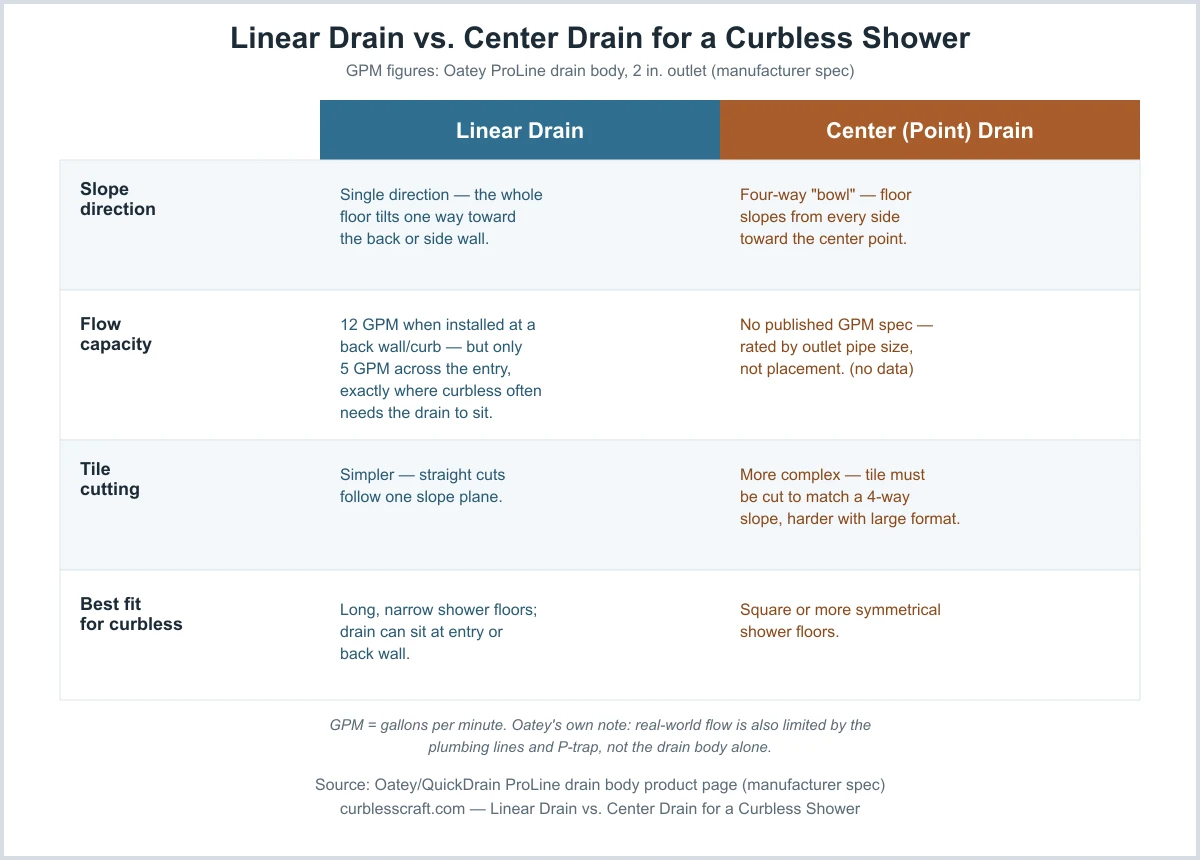
A linear drain lets a curbless shower floor slope in one direction, while a center drain needs a four-way slope like a bowl. Oatey’s own ProLine spec sheet shows a 2-inch linear drain delivers 12 gallons per minute at a back wall but only 5 gallons per minute installed across the entry.
Key takeaways
- A linear drain lets the whole shower floor slope in a single direction; a center drain needs a four-way “bowl” slope from all sides.
- Oatey’s ProLine 2-inch-outlet drain body is rated 12 GPM at a back wall or curb, but only 5 GPM installed across the entry — exactly where a curbless shower often needs it.
- There’s no published GPM spec for center drains; they’re rated by pipe size, not placement, so there’s no data for a direct comparison number.
- A single-direction slope usually means simpler tile cutting than a 4-way slope, especially with large-format tile.
- Oatey notes that real-world flow is also limited by the plumbing lines and P-trap, not the drain body’s own rating alone.
What’s the structural difference between a linear and a center drain?
A linear (trench) drain is a long, narrow channel, usually set along one wall. Because water only has to travel toward that one line, the entire shower floor can slope in a single direction — like a ramp. A center or point drain sits in the middle of the floor, so the floor has to slope down from all four sides toward it, like a shallow bowl.
That structural difference is also why linear drains fit naturally with the single-direction slope our floor slope requirements article describes: one slope plane, one direction, one drain line.
Does drain placement really affect flow capacity?
Yes — and this is the single most useful, verifiable number for this decision. Oatey’s own product page for its QuickDrain ProLine drain bodies states that the 2-inch-outlet version is rated for 12 gallons per minute (GPM) when installed against a back wall or curb, but only 5 GPM when installed across the entry. That second placement — across the entry — is exactly where a curbless shower frequently needs the drain to sit, since there’s no curb to hide it behind.
Oatey adds its own caveat: “actual volume is limited by the plumbing lines and P-trap,” meaning these GPM figures are the drain body’s own ceiling, not a guarantee of real-world performance once it’s connected to your home’s actual plumbing.
No data was found for a comparable manufacturer GPM spec for center drains. Most center/point drains are rated by outlet pipe size rather than a placement-dependent flow ceiling, so there isn’t a clean apples-to-apples number to put next to Oatey’s linear figures. If you see a specific center-drain GPM claim elsewhere, check whether it traces to an actual manufacturer spec sheet before trusting it.
| Linear drain | Center (point) drain | |
|---|---|---|
| Slope direction | Single direction — the whole floor tilts one way toward the back or side wall. | Four-way “bowl” — floor slopes from every side toward the center point. |
| Flow capacity | 12 GPM at a back wall/curb, 5 GPM across the entry (Oatey ProLine, 2 in. outlet) | No published GPM spec — rated by outlet pipe size, not placement (no data) |
| Tile cutting | Simpler — straight cuts follow one slope plane. | More complex — tile must be cut to match a 4-way slope, harder with large-format tile. |
| Best fit for curbless | Long, narrow shower floors; drain can sit at entry or back wall. | Square or more symmetrical shower floors. |
Which drain is easier to tile around?
A linear drain generally wins here. Because the floor slopes in one direction, tile cuts follow a single, predictable plane. A center drain’s four-way slope means every tile around the drain needs its own angled cut to match the bowl shape, which gets noticeably harder with large-format tile — the kind of tile that’s popular precisely because curbless showers are often marketed as a sleek, minimal-grout-line look.
Does the drain grate itself need to meet an accessibility standard?
Yes, if the shower is being built to ADA accessibility guidelines. The U.S. Access Board’s ADA Standards, §302.3 (Openings), require that any opening in a floor or ground surface — including a drain grate — not allow a sphere larger than 1/2 inch in diameter to pass through, specifically because wider openings let a wheelchair caster wedge into them. Where there is a dominant direction of travel across the surface, elongated grate openings must also be oriented with their long dimension perpendicular to that travel direction; where there is no dominant travel pattern, openings are limited to 1/2 inch in both directions.
That rule applies to either drain type, but it is easier to overlook on a linear drain, since its grate often sits directly across the curbless entry — the one spot in the room with a guaranteed dominant direction of travel. Before assuming a decorative grate pattern is interchangeable with the drain manufacturer’s own grate, check its opening size and orientation against this 1/2-inch rule.
Which drain fits a curbless shower better?
It depends on the shape of your shower floor more than a blanket rule. A long, narrow floor pairs naturally with a linear drain at the back wall or along one side, matching the single-direction slope. A more square or symmetrical floor can work well with either, though a center drain’s four-way slope may be simpler to frame in a perfectly square layout. If your floor is long and the drain has to sit near the entry for layout reasons, remember Oatey’s own number: that’s the 5 GPM placement, not the 12 GPM one.
What about the “10 GPM” DESIGNLINE figure you might see elsewhere?
Some sources cite a 10 GPM flow rate for Oatey’s DESIGNLINE linear drain series, sourced to a technical data sheet. That specific document returned a blocked response during this research pass, so that number is being treated here as second-hand rather than independently verified. If you want to rely on it for a real project, look up Oatey’s current DESIGNLINE technical data sheet directly rather than a third-party restatement of it.
Frequently asked questions
Does a center drain have a documented flow-capacity trade-off like the linear one?
No data was found for this. Oatey publishes placement-dependent GPM figures for its linear ProLine drains, but no comparable manufacturer spec surfaced for center/point drains in this research pass, since they’re typically rated by pipe size rather than installation position.
Is a linear drain required for a curbless shower?
No. A center drain can work in a curbless design; the choice mostly comes down to the shape of your shower floor and how the framing underneath can be sloped, not a fixed rule that curbless showers must use linear drains.
Which drain type costs less?
No verified cost comparison was found between drain types specifically. In general, the drain hardware itself tends to be a smaller line item than the structural and waterproofing work around it — see our cost breakdown article for how the bigger cost drivers are ranked.
Does a linear drain always have to sit at the shower entry?
No. Placement is a design choice, not fixed by drain type. Oatey’s own spec shows the same 2-inch linear drain body rated at 12 GPM at a back wall or curb, versus only 5 GPM across the entry — so where you put it changes its effective capacity.
Can I switch from a center drain to a linear drain in an existing shower?
Often, but it usually means re-sloping the floor, since a center drain’s four-way slope and a linear drain’s single-direction slope are built differently underneath the tile. That’s subfloor and waterproofing work, which calls for a licensed contractor rather than a tile-only swap.
Sources
- Oatey/QuickDrain, ProLine drain body product page (manufacturer spec)
- U.S. Access Board, ADA Standards for Accessible Design, Chapter 3: Floor and Ground Surfaces (drain grate opening size and orientation, §302.3)
curblesscraft.com Editorial Team. Last updated: November 13, 2026.





2 thoughts on “Linear Drain vs. Center Drain for a Curbless Shower”