Curbless Shower Leaking Into the Bathroom: Causes and Fixes
Curbless shower leaking into the bathroom? Five causes, from slope to drain placement, with which fixes are DIY and which need a licensed contractor.
Image: kayelleallen via Pixabay
A curbless shower leaks into the bathroom for one of five main reasons: insufficient floor slope, a waterproof membrane that doesn’t extend far enough past the shower opening, a gap around the glass panel or curtain, capillary wicking through grout, or a drain that can’t handle the flow where it’s placed. Some of these are simple DIY fixes; others mean reopening the floor and need a licensed contractor.
Key takeaways
- Without a curb, a curbless shower relies entirely on floor slope, membrane, and drain placement to keep water contained — there’s no physical barrier to fall back on.
- Code requires the finished floor to slope 1/4 to 1/2 inch per foot toward the drain (IRC §P2709.1); less than that is a common, fixable cause of pooling.
- Not every cause needs a contractor: splash-related leaks (gaps around glass or curtains, grout wicking) are often a DIY fix.
- Causes that touch the slope, membrane, or drain underneath the tile require reopening the floor, which needs a licensed contractor.
- There’s no verified, manufacturer-independent number for exactly how far a membrane must extend past the shower opening — follow your specific waterproofing system’s own instructions rather than a generic rule of thumb.
Why is a curbless shower more prone to leaking than a curbed one?
A curb is a physical dam: even if the slope or membrane is imperfect, the raised edge holds water back until it drains. Remove the curb, and the entire burden of keeping water inside the wet area shifts to three things working correctly together: the floor’s slope toward the drain, the waterproof membrane’s extent and condition, and the drain’s placement and capacity. A curbless shower isn’t inherently leak-prone — but it has no margin for error in any of those three systems, which is why diagnosing the specific cause matters more than it would in a curbed shower. If you’re still planning a build and want to avoid these causes from the start, see our curbless shower mistakes to avoid checklist and our curbless shower guide.
Cause 1: Insufficient floor slope
If water pools instead of draining, or collects at the far end of the shower pan, slope is the first thing to check. The International Residential Code’s §P2709.1 requires the finished shower floor to slope uniformly toward the drain “not less than 1/4 unit vertical in 12 units horizontal (2-percent slope) nor more than 1/2 unit vertical per 12 units horizontal (4-percent slope).” That’s a range, not one fixed number — 1/4 inch per foot is the code minimum, not the only slope the code allows. A common claim that some jurisdictions permit slopes as shallow as 1/8 inch per foot could not be verified against any code text in our research and should not be repeated as fact; if your contractor cites a different allowance, ask them to show the specific code section. Re-sloping a mortar bed or pre-sloped pan means removing tile and membrane, so this is a licensed-contractor repair, not a surface fix. For the full code range and a worked slope example, see our floor slope requirements guide.
Cause 2: Membrane not extended far enough past the shower opening
If stains or dampness appear on the floor or wall just outside the shower — not inside it — a likely cause is that the waterproofing membrane stops too close to the shower’s edge, letting water that reaches the floor surface migrate past the membrane’s boundary before it can drain back. The trade reference most installers use, the Tile Council of North America’s Handbook, describes methods (the B421, B422, and B422C family) for bonded waterproof membranes and integrated bonding-flange assemblies, and separately describes weep-hole protection for mud-set pans (the B414/B415 method family, where installers surround the drain with pea gravel or other weep protection so mortar doesn’t block the weep holes). We could not verify a single generic “extend the membrane X inches past the opening” number from an independently read TCNA source — treat any such number you see elsewhere as unverified, and instead follow the specific membrane manufacturer’s own installation instructions for your product, since extension distances are manufacturer- and system-specific. This is also a floor-reopening repair for a licensed contractor.
Cause 3: Gaps around the glass panel or curtain
If water escapes mainly near the open side of the shower — sprayed or dripped past a glass panel or curtain rather than pooling on the floor — the cause is usually containment, not slope or membrane. An undersized glass splash panel, a curtain that doesn’t overlap enough, or a shower head aimed directly at the open side are common, fixable culprits. This is generally a DIY-friendly fix: a wider splash panel, a properly weighted and hung curtain, or redirecting or replacing the shower head often solves it without touching the floor. See our glass vs. curtain vs. no-door comparison for how each containment option performs.
Cause 4: Capillary wicking through grout
If grout lines just past the shower’s wet-area line stay damp or discolor over time, water may be traveling sideways through porous grout or tile body — a phenomenon called capillary wicking — rather than flowing visibly across the surface. This is usually a DIY fix: removing and resealing the grout with a penetrating sealer addresses surface-level wicking. If staining keeps recurring under the tile after resealing, that points to a deeper moisture source and needs a professional inspection rather than repeated resealing.
Cause 5: Drain flow capacity doesn’t match where it’s placed
Linear drains have a documented, placement-dependent flow capacity that many homeowners don’t expect. Oatey’s own product data for its 2-inch-outlet ProLine drain body states 12 GPM capacity when the drain is installed against a back wall or with a curb, but only 5 GPM when the same drain is installed across the entry — exactly where a curbless shower often needs to place it. Oatey notes that actual real-world flow is also limited by the plumbing lines and P-trap, so these numbers are the drain body’s own ceiling, not a guarantee. If water escapes mainly during high-flow showerheads or rain heads, an entry-placed linear drain may simply be undersized for the fixture’s flow rate. Relocating or upsizing a drain is plumbing and floor work, so this is a licensed-contractor repair — check the specific drain’s manufacturer flow rating before assuming the fix is just “a bigger drain.”
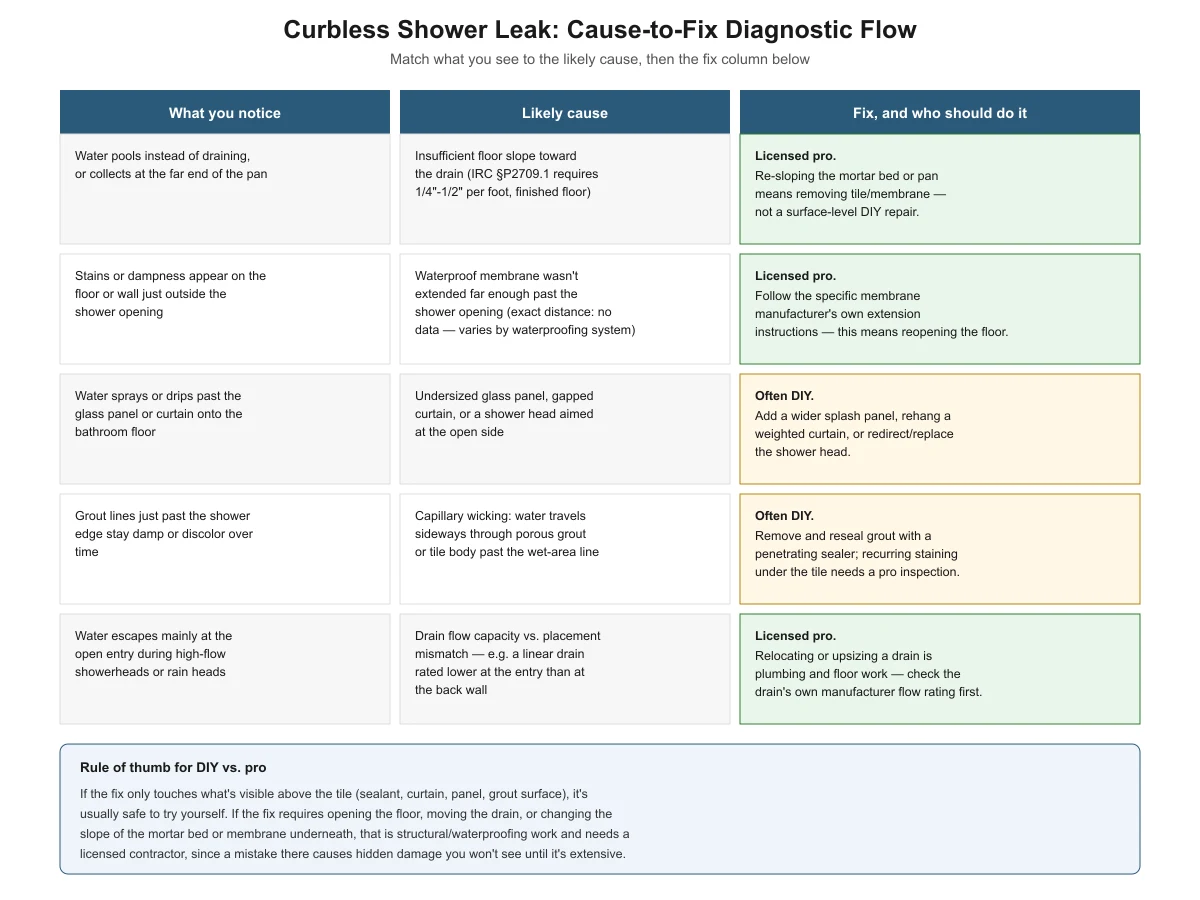
Diagnostic table: cause, sign, and who fixes it
| What you notice | Likely cause | DIY or licensed pro? |
|---|---|---|
| Water pools or collects away from the drain | Insufficient floor slope (below IRC §P2709.1’s 1/4″-1/2″ per foot range) | Licensed pro — requires removing tile/membrane |
| Dampness just outside the shower opening | Membrane not extended far enough past the opening | Licensed pro — floor must be reopened |
| Water sprayed or dripped past the glass/curtain | Undersized panel, gapped curtain, or misaimed shower head | Often DIY |
| Grout past the wet-area line stays damp or discolors | Capillary wicking through porous grout/tile | Often DIY (reseal); pro if staining recurs |
| Water escapes mainly at the entry under high flow | Drain’s flow capacity too low for its placement/fixture | Licensed pro — plumbing and floor work |
Frequently asked questions
Is a small amount of water outside a curbless shower always a sign of a leak?
Not necessarily — some splash beyond the wet area is normal with an open design, especially around a glass panel or curtain gap. It becomes a concern when the floor or wall stays damp after the shower is used, or when stains or discoloration develop over time, which points to an ongoing path for water rather than one-time splash.
What is the single most common cause of curbless shower leaks?
Our research doesn’t support naming one cause as most common without data from a neutral source — but insufficient floor slope and membrane extension issues are the two causes that require opening the floor to diagnose and fix, making them the most expensive to get wrong.
Can I fix a curbless shower leak without removing any tile?
Sometimes. Gaps around glass panels or curtains and grout-level capillary wicking can often be addressed without removing tile. Slope, membrane extension, and drain placement problems generally require removing tile to access the floor structure underneath.
How do I know if my membrane extends far enough past the shower opening?
There’s no single verified generic distance to check against — it depends on the specific waterproofing system used. Check that manufacturer’s installation instructions, or have a licensed contractor who installed (or can inspect) the system confirm it meets that product’s specification.
Does a linear drain leak more than a center drain?
Not inherently — but a linear drain’s flow capacity can vary significantly by where it’s installed, which a center drain’s doesn’t in the same way. If a linear drain sits at the shower entry rather than against a back wall, check its manufacturer-rated flow capacity at that position before assuming a leak is a slope or membrane problem.
Sources
- up.codes, 2021 IRC Section P2709 Shower Receptors (Colorado adoption, mirroring base IRC text) — up.codes
- Oatey, QuickDrain ProLine Drain Bodies product page — oatey.com
curblesscraft.com Editorial Team. Last updated: November 13, 2026.

2 thoughts on “Curbless Shower Leaking Into the Bathroom: Causes and Fixes”